Clearing it is easy. Making it stay clear is the job.
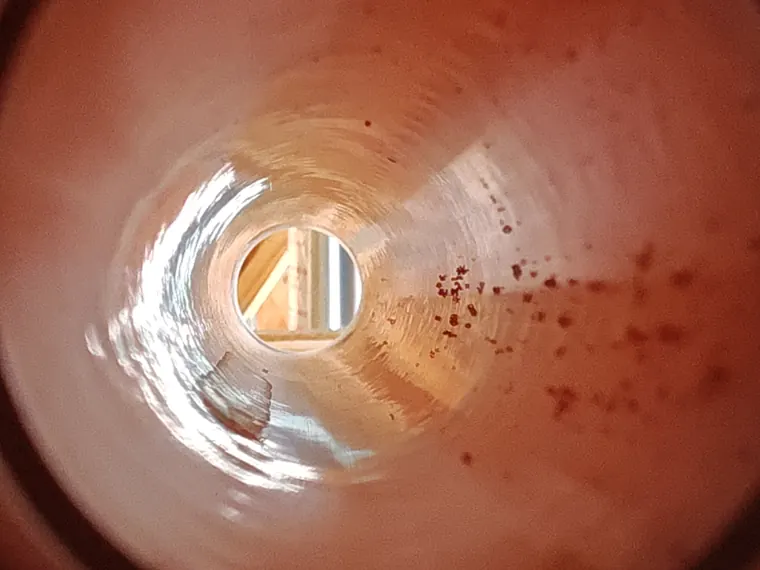
Anyone can punch a hole through a clog. We open the line, then put a camera down it to find out what caused it — so you're not calling someone again in March.
One slow sink is a nuisance. Everything at once is an emergency.
This is the single most useful thing to work out before you call anyone, and it takes about thirty seconds. Flush a toilet and run the tub at the same time.
More than one fixture backing up — that's the main line
Toilet gurgles when the washer drains. Tub fills when you flush. Sewage at the lowest drain in the house. That's not a clogged sink, it's the line that serves everything, and it will keep getting worse until someone opens it. Stop running water and call.
Kitchen sink
Almost always grease that cooled and set on the pipe wall, often with coffee grounds or starch stuck in it. Narrows over months, then closes in one evening.
Tub or shower
Hair bound up with soap scum, usually within arm's reach of the drain. The easiest one to fix properly and the easiest one to make worse with chemicals.
Bathroom sink
Toothpaste, hair and soap around the stopper mechanism. Often clears at the trap without going near the main line.
One toilet only
Something went down that shouldn't have — wipes are the usual answer. If only that toilet is affected, the problem is in or just past it.
Laundry backing up
Lint and detergent build-up, or a washer standpipe that was never sized right. Watch whether the toilet reacts when it drains — that changes the answer.
Outside cleanout overflowing
Water standing at the cleanout in the yard means the blockage is between the house and the city main — roots and collapsed pipe live down there.
Three tools. They are not interchangeable.
Most call-backs happen because the cheap tool got used on a job that needed the right one. Here's the plain difference, including when the cheap one is genuinely enough.
Cable machine — "snaking"
A steel cable with a cutting head spun down the line. It bores through the blockage and restores flow fast. What it does not do is take the grease or scale off the pipe wall — it makes a hole through it.
Right for: a single fixture, first time, get-it-working-nowHydro-jetting
High-pressure water on a rotating head that scours the pipe back to its own wall — grease, sludge, scale, root hair. It's the difference between a hole through the clog and a clean pipe.
Right for: repeat clogs, kitchen lines, main lines, restaurantsCamera inspection
A camera down the open line to see what's actually there: roots at a joint, a belly holding water, a cracked section, or just grease. It turns "it'll probably be fine" into a picture you can look at.
Right for: second clog in the same line, anything in the main, before you buy a houseHow we decideWe open the line first, because you want water running again. Then we tell you whether what we saw needs jetting or a camera — and if a cable was genuinely enough, we say that too and leave.
Book a drain call
Four reasons a drain clogs twice
If you've had the same line opened more than once, the clog isn't the problem — it's the symptom. One of these four is usually underneath it.
Tree roots
Roots find the joint, get in through a hairline gap, and grow into a mat that catches everything passing. They come back every season unless the pipe is dealt with.
A belly in the line
A section that sagged, so water stands in it instead of running through. Solids settle in the low spot. No amount of cabling fixes a shape problem — but a camera shows it.
Grease, cooled and set
It goes down the drain warm and liquid and sets on the pipe wall as it cools. The city of Tampa calls the result a "fatberg" once it combines with wipes.
"Flushable" wipes
They don't break down like paper. They catch on anything rough inside the pipe and build from there, which is why they're the single most common thing we pull out of a main line.
Your city says the same thing, with a number attached
This isn't a plumber trying to sell you something. The City of Tampa asks residents to "discontinue flushing wipes and stop pouring grease down your drains," because when the two combine in pipes "they form 'fatbergs'."
Over three days, a city contractor removed 108 cubic yards of grease and non-flushable wipes from the wet well at one pump station.
And on who pays when it happens at your house, the city is blunt: a backup "may lead to an expensive plumber's bill – at your cost." We'd rather you avoid that bill than pay us for it twice.
Source: City of Tampa, Fats, Oils and Grease and Non-Flushable Wipes
Why there's no price on this page
A sink that clears in twenty minutes at the trap and a main line that needs a jetter and a camera sound exactly the same when you describe them on the phone. Quoting before we've seen it means guessing, and guesses get padded.
What we will do is tell you the number on site, before the machine comes off the truck, and not touch anything until you say yes.
- Which line it isA fixture trap and a main line are different jobs with different machines.
- Whether there's a cleanoutAn accessible cleanout saves time. No cleanout means pulling a toilet or going through the roof vent.
- Cable or jetterJetting is a bigger machine and a longer job — and the one that stops it coming back.
- Camera, or notOptional on a first-time sink clog. Worth every dollar on a repeat, and on anything in the main.
- Time of dayNights, weekends and holidays. Billed at 1.5× the regular rate.
- What we find underneathRoots or a broken section is a repair, not a cleaning — and we show you the footage first.
What people ask while the water's rising
Short answers, the way we'd give them on the phone.
Should I pour a bottle of drain cleaner down it first?
We'd rather you didn't. If it doesn't clear the blockage, you now have a pipe full of caustic liquid sitting on the clog — which can attack older pipe and which someone has to work in when they open it. Tell us if you already used one; it changes how we approach the job and it's a safety thing, not a judgement.
Do I really need the camera?
First clog in a bathroom sink — no. Second clog in the same line, anything in the main, or a house you're about to buy — yes, and we'd say so even if you didn't ask. The camera is how you find out whether you're buying a clearing or a repair.
Will it come back?
If the cause was a one-off object, no. If it was grease, roots or a belly, a cable job buys months and a jetting buys much longer — and a belly comes back regardless until the pipe is fixed. We'll tell you which of those you have before we leave, not after you call again.
Can you come today?
Often yes — drains are most of what we do, and we run 24 hours. Call rather than text if water is actively backing up; the dispatcher can move things around on the phone in a way a form can't.
Is a backup covered by my insurance?
Ask your carrier — policies differ and we're not your adjuster. Worth knowing that the City of Tampa states plainly that a backup caused by flushing wipes or pouring grease "may lead to an expensive plumber's bill – at your cost." If there's water damage, photograph it before anything gets cleaned up.
What about the garbage disposal — can I put that down there?
A disposal grinds food; it doesn't change what happens downstream. Grease, coffee grounds, rice and pasta all still end up on the pipe wall. Run cold water while it works, and keep grease out of the sink entirely — let it cool in a can and bin it.
We're a restaurant. Is this the same service?
Same tools, different scheduling. Commercial kitchen lines need jetting on a routine, not on failure, and we'd rather run it before service than during it. We also do grease traps and full build-outs — talk to us about a maintenance interval instead of paying emergency rates twice a year.
Water going the wrong way?
Call and talk to a person — a dispatcher can triage a backing-up main faster than any form. Or book a window if it can wait until tomorrow.