Every other part of your plumbing is hidden. This is the part you touch ten times a day.
Toilets, faucets, disposals, shower valves, tub fillers and the shut-offs behind them. Small jobs, done properly, by someone who will tell you when repairing is smarter than replacing.
Two reasons people call about a fixture
They want completely different conversations, so tell us which one you are and we'll skip to it.
Something stopped working
A drip, a run, a wobble, a disposal that hums and does nothing
- Most of these are a part, not a fixture. A flapper, a fill valve, a cartridge, a wax ring.
- We carry the common ones, so the usual outcome is fixed on the first visit.
- When the part costs more than the fixture, we'll say so rather than quietly fit it.
You're changing something
A new faucet, a remodel, a fixture already sitting in the garage
- Send a photo of what's there now and what you've bought. Half the surprises die right there.
- Deck holes, rough-in dimensions and valve bodies are the three things that don't match. Better found before the old one comes out.
- Bought it online? Read the section below before we come.
Six things that break, and what they usually mean
Most fixture faults are cheap parts. A few are the fixture telling you it's finished. Here's how we read each one before we quote anything.
A toilet that keeps running
Almost always the flapper or the fill valve, and both are inexpensive parts. It's also the single most common hidden leak in a house, quietly adding to your bill every hour it runs.
A faucet that drips
Usually a cartridge, and in our water usually a cartridge that scaled up. Worth replacing the part on a decent faucet. Not worth it on a builder-grade one where the body is already pitted.
A toilet that rocks
Not the toilet. Usually the flange underneath it, the wax seal, or the bolts. Left alone it becomes a slow leak into the floor, and then it stops being a small job.
A disposal that hums
Humming means power is reaching it and something is jammed. That's often a free fix with the right tool. Silence usually means it's done, and the good news is a replacement is a straightforward swap.
A shower that swings hot and cold
Someone flushes and you get scalded, or the temperature drifts on its own. That's the balancing valve, and on an older one it's usually a cartridge rather than opening the wall.
A shut-off valve that won't shut off
The little valve under a sink or behind a toilet. Old multi-turn ones seize open, and you discover it at the worst moment. Replacing them with quarter-turn valves while we're already under there is the cheapest insurance in plumbing.
We'd rather fit a two-dollar part than sell you a fixture.It's how people call us back, and how they tell their neighbours about us.
Book a fixture jobYour shower valve has a legal temperature limit, and it does not arrive set
This is the part of a fixture install that separates a licensed plumber from a handyman, and it is invisible once the trim plate goes on.
Florida Plumbing Code, section 412.3
Shower and tub-shower valves have to be balanced-pressure, thermostatic, or a combination of the two, meeting ASSE 1016/ASME A112.1016/CSA B125.16 or ASME A112.18.1/CSA B125.1
. So far, so ordinary. The part people miss comes next.
The valve must have a means of limiting its maximum setting to 120°F (49°C)
, and that limiter shall be field adjusted in accordance with the manufacturer's instructions
. Field adjusted. It is not set at the factory, and every valve does it differently.
The code also says these valves go in at the point of use, and that an in-line thermostatic valve somewhere else in the house does not satisfy the requirement.
In plain terms: if nobody adjusted the stop when your shower valve went in, your shower can deliver water hotter than the code allows, and you would never know until someone small gets in it. We set it, every time, and we'll check an existing one for you while we're there.
Quoted from the 2023 Florida Building Code, Plumbing, 8th edition, chapter 4, section 412.3. Separately, the temperature your water heater is set to is a different decision with its own trade-offs, and it is worth talking through rather than guessing.
Tampa Bay water is hard on fixtures. Literally.
Scale is why cartridges stick, why aerators clog, why a glass shower door goes cloudy and stays cloudy, and why a faucet here does not last as long as the same faucet somewhere else.
What it does to a fixture
- Aerators clog, so the flow goes weak and skewed. Often a five-minute clean rather than a new faucet.
- Cartridges scale and stiffen, then start passing water. That's your drip.
- Shower heads block hole by hole until the spray pattern goes sideways.
- Toilet fill valves and flappers wear faster, which is why the running-toilet problem is so common here.
Before you buy an expensive faucet
It's worth knowing how hard your water actually is, because a premium fixture in untreated hard water ages like a cheap one. Softening changes the arithmetic on everything you're about to install.
We are not going to push a softener at you on a page about faucets. But if you are spending real money on fixtures this year, it is the conversation to have first rather than third.
How softening worksThe numbers behind a fixture swap
Not a sales pitch, just the published figures. They matter most if your house still has its original toilets.
Figures from EPA WaterSense, residential toilets and bathroom faucets. The toilet saving is quoted as more than $170 a year and around $3,400 over the life of the toilets. None of this means you should replace a working fixture, and we will not tell you that you should. It means that if one is already failing, the replacement pays for part of itself.
What we set
From a fill valve on a Tuesday to a full trim package on a custom bathroom.
Toilets
Flappers, fill valves, flanges and wax seals, right through to a new pan. If you're buying one, check the rough-in dimension from the wall to the bolts first. Twelve inches is standard, but ten and fourteen both exist and neither is interchangeable.
Faucets, kitchen and bath
Cartridge swaps, full replacements, and the deck-hole problem nobody warns you about: a single-hole faucet on a three-hole sink needs a plate, and a widespread will not fit a centerset. Photograph your sink before you order.
Disposals and sink drains
Jams cleared, units replaced, and the drain assembly under the sink put back properly rather than held together with tape. If a dishwasher drains through it, the loop matters and we do it right.
Shower and tub valves
Cartridges and trim from the front where we can. Where the valve body itself has to change, the wall opens, so we will tell you that before starting rather than after. And the 120 degree stop gets set, every time.
Not a handyman jobTub fillers and freestanding tubs
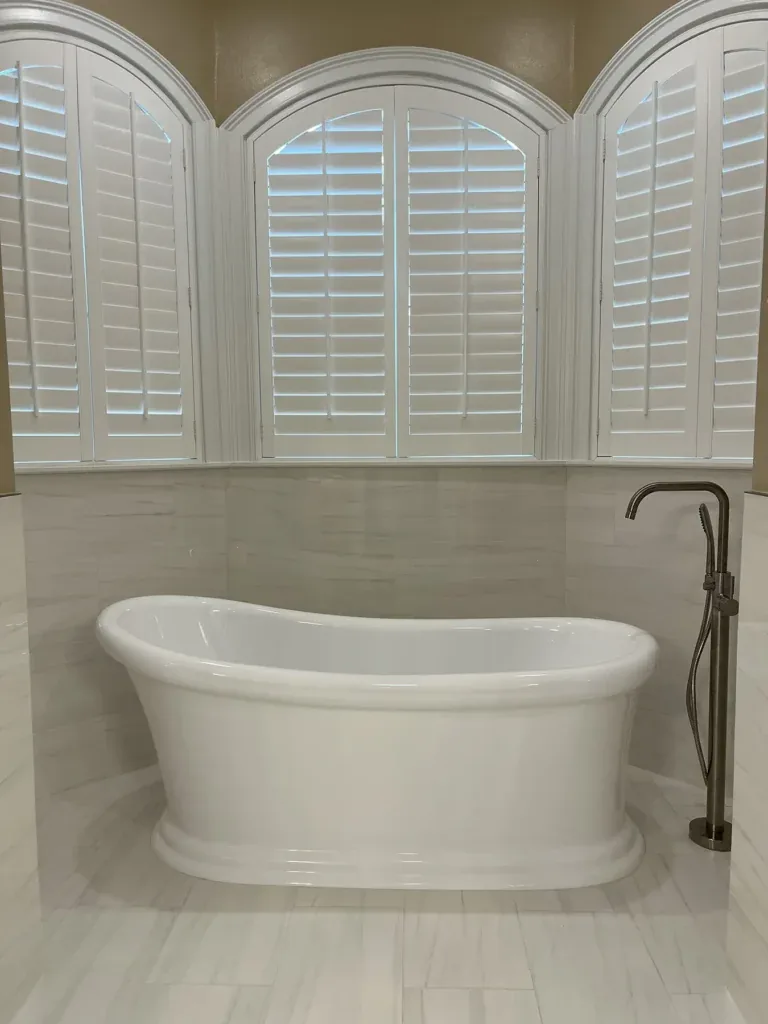
The showpiece fixtures, and the ones least forgiving of a rough-in that's an inch off. Worth involving a plumber at the point you choose the tub, not the week it arrives.
Shut-off valves and supply lines
Quarter-turn stops and braided connectors behind every fixture. Nobody ever asks for these. Everybody who has ever had a supply line burst at two in the morning asks for them afterwards.
Recirculation pumps
If the far bathroom takes a minute to run hot, that minute goes down the drain every single time. A recirculation pump fixes it, and it pairs with the water heater decision rather than being separate from it.
Water heatersOutdoor showers, bidets, pot fillers
Anything that needs a supply run to somewhere it has never been. These are the jobs where the fixture is easy and getting water and drainage to it is the real work, so ask early.
Commercial fixtures
Flush valves rebuilt or replaced, wall-hung carriers, sensor faucets and the mop sinks nobody photographs. Different hardware, different failure modes, same trade.
Commercial workYou bought it online. Now what?
Half the fixtures we fit these days arrive in a box the customer ordered. That's fine, and there are three things worth knowing before we're standing in your bathroom holding it.
What to check before we arrive
- Open the box now, not on the day. Missing parts and shipping damage are common, and finding out on arrival costs you a second visit.
- Check it fits what you have. Toilet rough-in, sink deck holes, valve body compatibility. A photo of both, sent with your booking, prevents most of this.
- Keep the paperwork. The warranty on a fixture you supplied is between you and the manufacturer, and they will ask for proof of purchase.
The honest part
We warrant our work either way. What we cannot warrant is a fixture we didn't supply, because we have no relationship with whoever made it and no way to get a replacement part quickly when it fails.
That is not an argument against buying your own. Plenty of people find exactly what they want online and there is nothing wrong with that. It just means that if the cartridge fails in year two, the chase is yours rather than ours.
We'll install fixtures you supply, but that work carries no warranty.
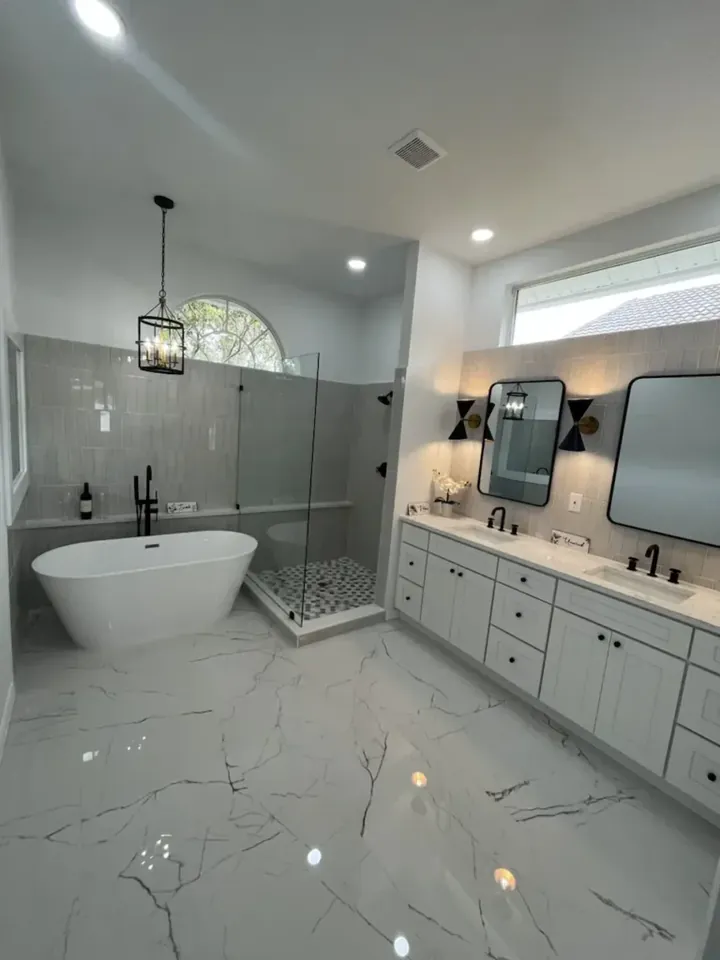
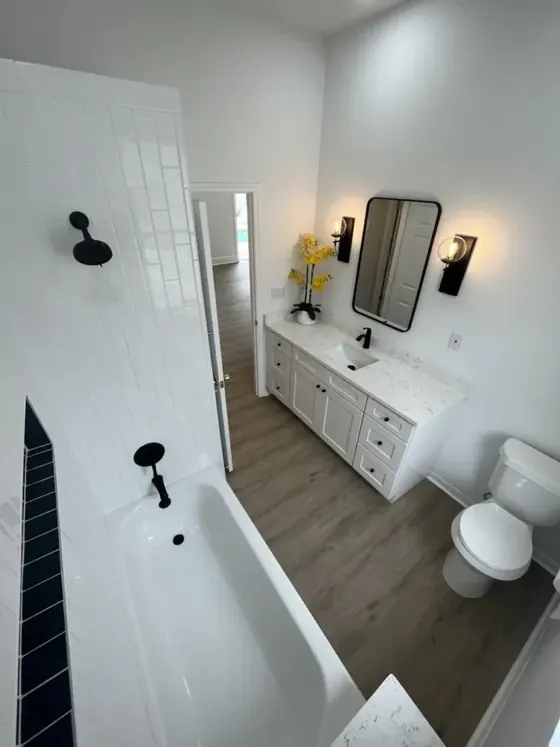
Our work
Finished bathrooms from jobs this crew trimmed out.
Why there's no price on this page
A dripping faucet is either a fifteen-minute cartridge or a fixture whose threads have corroded into the sink, and both look identical from your kitchen. A toilet reset is straightforward until the flange under it turns out to be broken.
We would rather turn up, look, and tell you the real number than publish one that only applies to the easy version. The good news on this page is that fixture work is the cheapest end of plumbing, and often cheaper than people expect.
- Part or whole fixtureA cartridge and a replacement are different jobs.
- Who supplies itYours, or one we bring with a warranty behind it.
- What's behind itCorroded stops and seized nuts turn ten minutes into an hour.
- Whether the wall opensTrim from the front, or a valve body change behind tile.
- How many at onceFour faucets in one visit costs less each than four visits.
- When you need usA scheduled visit and a midnight call are not the same.
What people ask
Will you fit a faucet I bought myself?
Yes. Open the box first and check nothing's missing or damaged, and send us a photo of the sink it's going on. The only thing that changes is the warranty: we stand behind our labour, but a fixture we didn't supply is covered by whoever made it, not by us.
Is it worth repairing a faucet or should I just replace it?
Depends almost entirely on what the faucet is. A good one is worth a cartridge many times over. A builder-grade one where the body has already corroded is throwing a part at a losing position. We'll tell you which you have, and we have no incentive to get it wrong because the repair is the smaller job for us.
My shower goes cold when someone flushes.
That's the pressure-balancing valve not balancing any more, and it's usually the cartridge inside it rather than the valve body. Most of the time it's a job done from the front without opening tile. While we're in there we'll check the temperature stop is set to the code limit, because on older installs it frequently isn't.
How do I know what toilet to buy?
Measure from the finished wall behind it to the centre of the bolts holding it down. Twelve inches is standard; ten and fourteen exist and won't fit each other. After that it's comfort height or standard, one piece or two, and whether you want a WaterSense model at 1.28 gallons per flush. Send us the measurement and we'll tell you if anything else matters.
Can you put a bidet sprayer on my existing toilet?
Usually, yes, and it's a small job. The variables are whether there's a convenient supply to tee off and whether you want a simple sprayer or a seat that needs power nearby. Tell us which you're imagining and we'll tell you what it takes.
Do you do just one small thing, or is there a minimum?
We take small jobs. If you have several small things, save them up and have us do them in one visit. A list of five annoyances handled in an afternoon is far better value than five separate call-outs.
My new faucet has terrible pressure and the old one was fine.
Two usual causes. Either the aerator has caught debris knocked loose during the install, which is a clean rather than a fault, or the new faucet is a lower-flow model than the old one and is behaving exactly as designed. Both are worth checking before anyone assumes the fixture is bad.
Save up the small stuff. We'll do it in one visit.
A running toilet, a dripping faucet, a disposal that quit and a shut-off valve you don't trust. One afternoon, one visit, and a list you stop thinking about.