
Anyone can find a leak with a jackhammer. The skill is finding it without one.
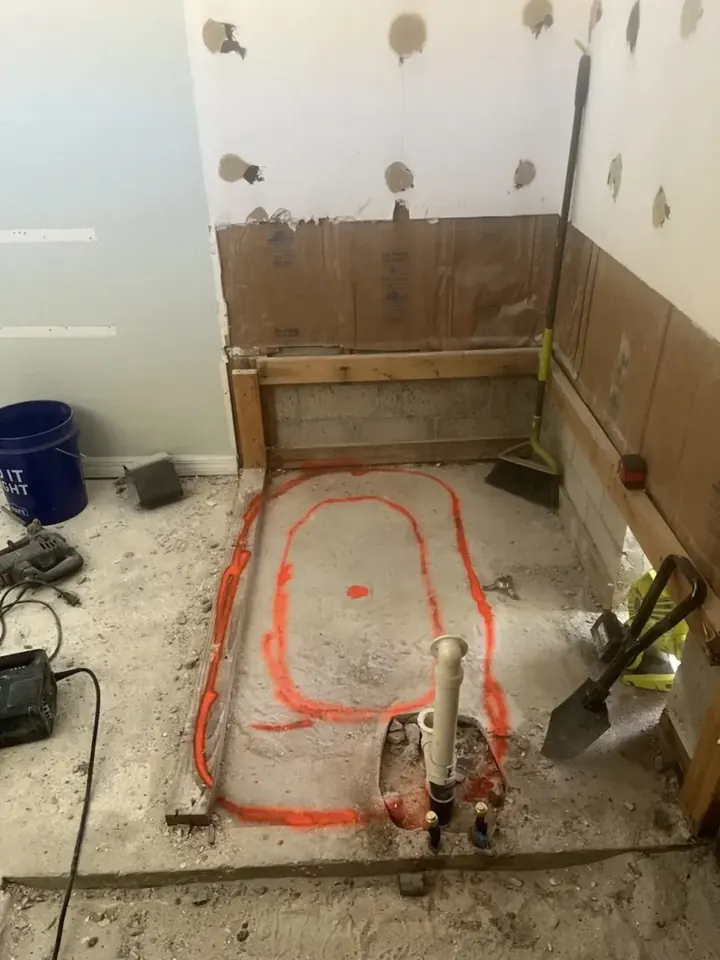
Listening gear, pressure isolation and a thermal camera go first. We mark the spot on your floor, show you why we're confident, and open only that. No exploratory holes.
Two very different phone calls
Tell us which one you are and we'll treat it accordingly. One of them should call right now rather than text.
Water is coming out right now
Visible water, a burst line, a ceiling going soft
- Shut the water off first. Use your house's own valve, usually outside near the front hose bib, and turn it clockwise until it stops. Leave the valve inside the meter box alone: it belongs to the water utility. No valve of your own? The utility can shut the water off at the street.
- Kill the water heater if the tank is draining. Gas to pilot, or the breaker off for electric, so the element doesn't fire dry.
- Photograph everything before you mop. Wet carpet, stained ceiling, the pooling itself. Your insurer will ask.
- Then call. Say the water is active and we will treat it as an emergency, day or night.
You suspect something hidden
A bill that jumped, a smell, a warm patch, a stain that keeps coming back
This is the one worth doing properly rather than quickly. Before you pay anybody, run the two free checks below. They take fifteen minutes, they cost nothing, and they rule out the cheapest causes first.
If the meter says water is moving and your toilets are clean, that's when a detection visit is worth the money, because now we know there is something real to find.
Run the free checks firstYour meter already knows
Every meter in Tampa has a small red triangle on the face. It spins when water moves, however slowly. With everything in the house shut off, it should sit perfectly still.
The meter test
About fifteen minutes, or two hours if you want to catch a slow one
- Turn off every tap, inside and out. Irrigation off. Ice maker off. Nobody flushes for the duration, which is the part that usually goes wrong.
- Open the meter box at the curb, in line with your front hose bib. Lift the lid and wipe the glass. You are only reading the meter, so leave the valve in there alone.
- Find the small red triangle on the face. That's the leak detector. Watch it for a minute.
- For a slow leak, write the numbers down, leave the house alone for two hours with no water used at all, and read it again. The two readings should be identical.
The toilet dye test
Fifteen minutes, and it is the single most common hidden leak in a house
- Take the lid off the tank. Set it somewhere it can't fall.
- Drop in a dye tablet, or five drops of food colouring. Do not flush.
- Wait about fifteen minutes, then look in the bowl.
- Colour in the bowl means a leak past the flapper or the valve. No colour means that toilet is sound. Repeat on every toilet in the house.
A silent running toilet is the leak people live with for years without noticing. The City of Tampa suggests doing this twice a year on every toilet, and it is worth the ten minutes.
Meter and dye-test steps follow the City of Tampa's own leak-check guidance; Hillsborough County publishes the same two-hour meter comparison. Waste figures are from EPA WaterSense, Fix a Leak Week. You will see "10 percent of homes, 90 gallons a day" quoted all over Florida plumbing sites. That is EPA's retired 2017 figure. The current numbers are the ones above.
The house tells you before the bill does
Any one of these on its own can be innocent. Two together is worth a phone call.
A warm patch on the floor
Walk the house barefoot. A spot of tile that's warmer than the tile around it usually means the hot line under the slab is losing water right there. It's the one symptom that points at its own location.
Running water with everything off
Stand still in a quiet house at night. A faint hiss or trickle behind a wall or under the floor is water escaping under pressure. Your ears are a legitimate diagnostic instrument here.
A stain that comes back after you paint it
Paint covers a stain. It does not stop the water making it. If a ceiling or wall mark reappears within a few months, something above or behind it is still wet.
Musty smell in one room
Especially a closet, a cabinet under a sink, or along one wall. Florida humidity hides a lot, but a smell that lives in one place and nowhere else is telling you where to look.
New cracks, or tile that has lifted
Water under a slab washes the soil out from beneath it and the slab follows. Cracks, a door that suddenly sticks, grout that's opened up. At this point the plumbing bill is no longer the biggest one.
A wet stripe in the lawn
Irrigation leaks are the quietest money you lose in Florida, because the water goes exactly where you were going to put it anyway. Ground that stays soft with no rain, or grass greenest in a line, is the tell.
Narrow it down, then prove it, then mark it
Detection is a process of elimination, not a magic wand. Each step removes possibilities so the next one has less ground to cover.
Isolate which system is losing water
Valve by valve we separate hot from cold, house from irrigation, and the service line from everything inside. If the meter stops when one branch is closed, we've just halved the search area without touching the building.
Pressure-test what's left
An isolated section gets held under pressure and watched. A section that holds is innocent. A section that drops is where the water is going, and now we know within a run of pipe rather than within a house.
Listen for it
Water escaping a pressurised line makes a distinct noise, and a ground microphone on the slab picks it up where an ear can't. We walk the suspect run and the sound peaks over the leak.
This is the step that does most of the work on slab leaks, and it is why the equipment is worth what it costs.
Confirm it a second way
A thermal camera shows a hot-side leak as a warm plume spreading under the floor. For stubborn cases, tracer gas goes into the empty line and comes up through the slab exactly where the hole is. For drains and sewer, it's a camera and a locator instead.
Mark it, photograph it, and stop
The spot gets painted on your floor and photographed, and we show you what convinced us. Nothing opens until you've seen the mark and agreed to the repair. That photo at the top of this page is exactly this step.
Six places a Florida house leaks
Same symptom on your bill, six completely different jobs behind it.
Under the slab, hot side
The most common slab leak we get called to, and the easiest to confirm because it heats the floor above it. Also the most urgent: it's losing hot water continuously, so it runs your water heater and your bill at the same time.
Don't sit on this oneUnder the slab, cold side
No warm patch, no clue underfoot, so it usually surfaces as a bill or a crack. Found by isolating the cold branch and listening, and it is the reason the meter test above matters so much.
Inside a wall
Often at a fitting, a shower valve or a hose-bib penetration. Usually the smallest repair on this list once it's located, because opening drywall and closing it again is nothing next to opening concrete.
The service line from the meter
Buried, under the yard or the driveway, and entirely yours rather than the utility's. A soft patch of ground on the line between meter and house is the usual first sign.
Irrigation
A valve that doesn't close fully, or a cracked lateral, and the evidence soaks straight into the lawn. Worth isolating separately in every single test, because it flatters the house into looking innocent.
A drain or sewer line
Drains only leak while something is draining, so pressure tests and listening gear don't apply. These get a camera and a locator instead, which is a different visit with different equipment.
See sewer line workPools and spas. A pool losing water is its own speciality with its own equipment, and plenty of plumbers refer it out rather than pretend. We do too: pool leak work goes to a trusted partner.
Finding it is half the job. Here's the other half.
Once we know where it is, there are three honest answers, and which one you get depends on what the pipe is made of and how old it is.
Open it and repair it
Cut in at the mark, replace the failed section, close it up. The right call when the rest of the system has life left in it, and the reason we spend so long being sure of the mark.
Re-route around it
Abandon the failed run under the concrete and bring a new line overhead or through walls instead. Depends entirely on where your fixtures sit, but when it works, your floor never gets opened at all.
Always checked firstRepipe the house
If the pipe is polybutylene or old galvanized and this is not the first pinhole, chasing the next one is throwing money at a system that has decided to fail. We'll tell you when we think you've reached that point.
How repiping worksOur work
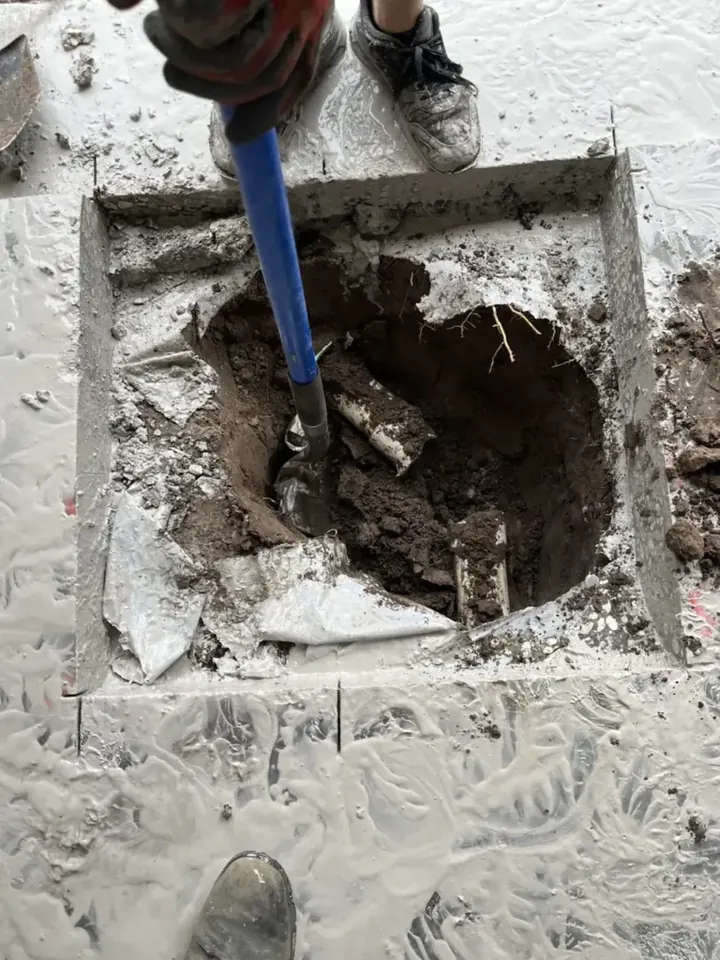
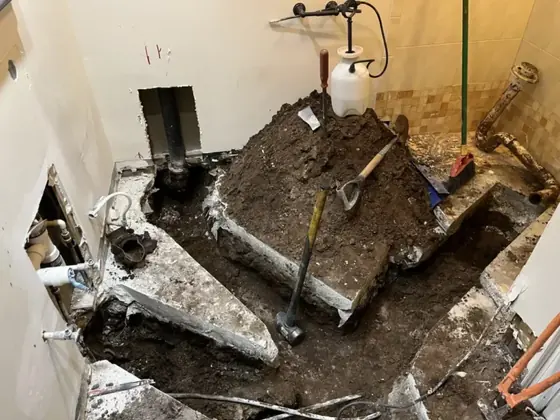
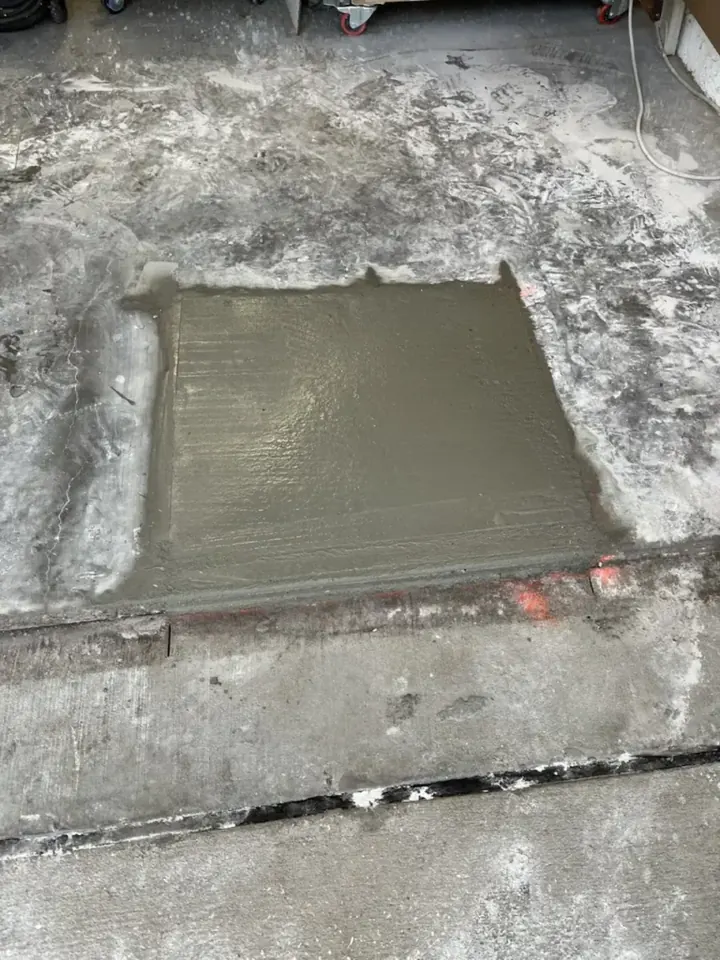
Located, marked, opened, repaired, closed. What slab leak work actually looks like.
Why there's no price on this page
A leak that turns out to be a toilet flapper and a leak that turns out to be forty feet of pinholed copper under a tiled floor both start as the same phone call. Any number quoted before the first one is ruled out is a number somebody made up.
What we can promise is the order of operations: the cheap causes get eliminated first, you see the mark before anything opens, and the repair gets priced against what we both looked at.
- How much ground there is to coverA single bathroom versus a whole house on one meter.
- What the floor isBare slab, tile, hardwood or a finished room full of furniture.
- Whether it's constant or intermittentA leak that only runs sometimes takes longer to catch.
- How the house is valvedGood isolation valves cut the search time. Many older houses have none.
- Whether you need a written reportFor an insurance claim, say so upfront and we'll document as we go.
- The repair, priced separatelyDetection tells us what the repair is. They are two decisions, not one.
What people ask
Will my insurance pay for this?
Ask your carrier, because we're plumbers and not adjusters. What we can tell you is the pattern we see: policies often treat the water damage and the cost of getting at the pipe differently from the pipe itself. Either way, a dated report with photographs of what we found and where is the evidence an adjuster asks for, so tell us at booking if you're claiming and we'll document accordingly.
Can you really find it without breaking anything?
Detection itself is non-destructive, yes. The repair is not, and anyone promising otherwise on a slab leak is selling something. The honest version is this: the equipment is what keeps the opening small and in one place instead of exploratory holes across the room.
My bill doubled but I can't see anything wrong.
That's the normal presentation, and it's why the meter test above is the first thing to do. Run it before you pay anybody. If the triangle is still, check whether the jump lines up with a new irrigation schedule, houseguests, or a pool top-up. If it's moving, you have something real and you'll know it in a quarter of an hour.
Is a slab leak an emergency?
It isn't a burst pipe, so it rarely needs a two in the morning call-out. It is also not something to leave until next quarter, because the water is washing soil out from under your foundation the whole time it runs. Days rather than months is the right timescale, and a hot-side leak sits at the urgent end of that.
Where is my main shut-off?
In most Florida houses it's outside, near the front hose bib, sometimes behind a small access panel or low in the yard between the meter box and the house. Find it now, on a calm afternoon, rather than at the moment you need it. Turn it clockwise to close. The valve inside the meter box is not yours to use: it belongs to the water utility, and in Tampa only the city is allowed to turn it. If your house has no valve of its own, the utility can shut the water off for you, and it's worth having one fitted.
Do you fix it the same visit?
Often, when it's accessible and we're carrying what it needs. Under a slab, or where a re-route is the better answer, it's usually a second visit with the right crew and materials. We'll tell you which it is as soon as we've marked it, not after we've started.
The leak is in the wall between me and my neighbour.
Common in condos and townhouses, and the plumbing is usually the simpler half of it. Who pays and who authorises access depends on your association's documents, so it's worth having that answer ready before we arrive. We're happy to work with a property manager directly if that's cleaner.
Run the meter test first. Then call us.
It's free, it takes fifteen minutes, and it tells you whether you have a problem worth paying to find. If it does, we'll find it without taking your floor apart to look.