Tampa Bay water is very hard. Your appliances already know.
Spots you can't wipe off, skin that feels tight, a water heater that died early. We test what's actually coming out of your tap, size the system to it, and tell you honestly if you don't need one.
Four different water problems get called "hard water"
They need four different pieces of equipment. Selling a softener for an iron problem is how people end up with a tank in the garage and the stains still there.
White scale and spotting
Crust on the faucet, film on the glasses, soap that won't lather. That's calcium and magnesium — the textbook case, and what a softener is built for.
Orange or brown staining
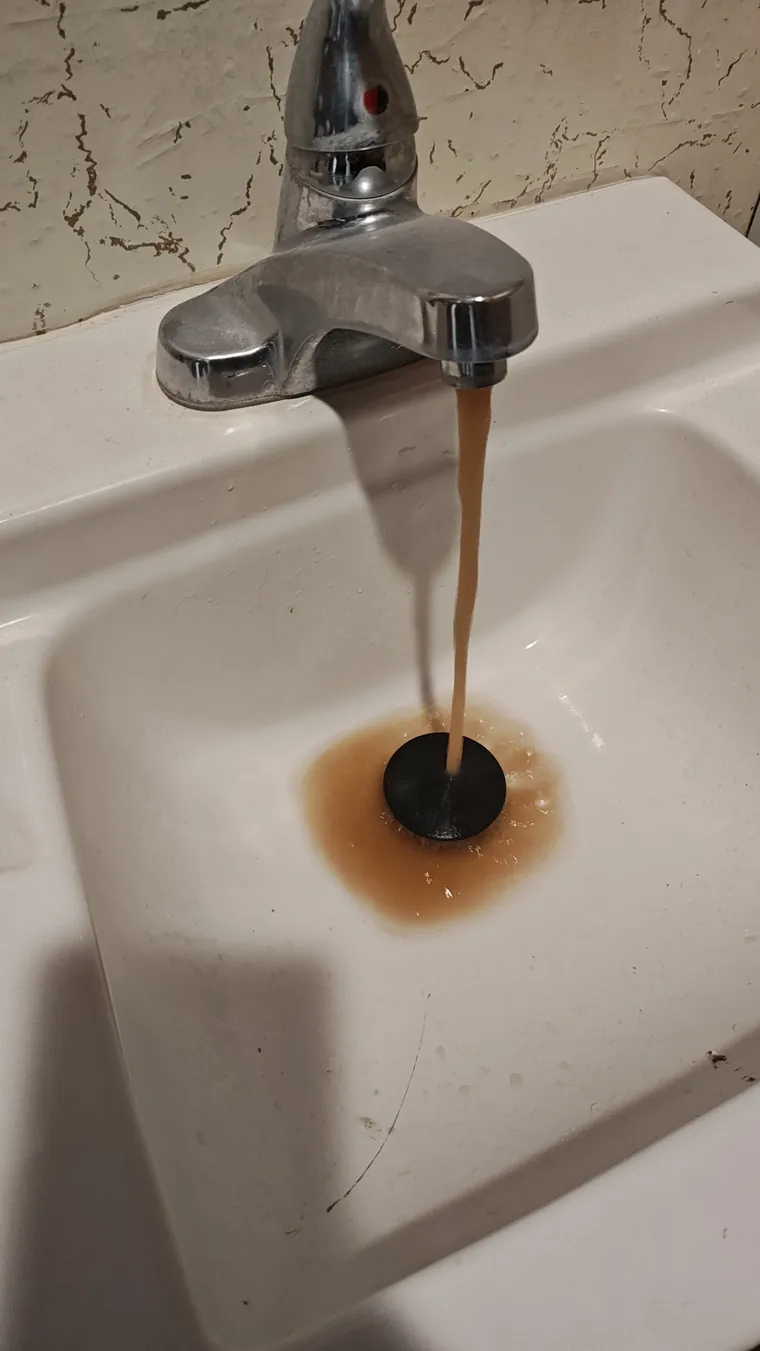
Rings in the toilet, rust marks on the tub, discoloured laundry. That's iron, and it needs iron treatment — a plain softener alone will struggle and can foul.
Rotten-egg smell
Sulphur, and common on well water here. It's a smell problem, not a hardness problem, and it's treated separately — often with aeration or a specific filter media.
Chlorine taste or smell
City supplies are disinfected, and some people taste it. Carbon filtration handles that — it's a separate stage from softening, and often the cheaper thing to fix.
This is why we test firstA test strip and fifteen minutes at your tap tells us which of these you actually have. It costs you nothing to find out you don't need the expensive answer.
Book a water testYour utility publishes this. Most people never look.
We don't need to convince you the water is hard — your own water company already said so in its annual report.
Pinellas County's 2025 report gives total hardness of 217 mg/L, range 189–244, and translates it for you: "Water softener setting for hardness: equivalent to 11.1 – 14.3 grains per gallon." The City of Tampa reports 211 mg/L, or 12.3 grains. St. Petersburg reports 158 mg/L.
On the USGS scale, anything above 180 mg/L is "very hard" — the top band there is.
Figures from the utilities' own 2025 water quality reports. Pasco, Hernando, Hillsborough and Clearwater don't publish a hardness number at all — we say so on our water page rather than making one up.
A DOE lab put numbers on the damage
Not a brochure claim. This is testing reported by a US Department of Energy laboratory.
Gas water heater
Scale took a gas storage heater from 70.4% down to 67.4% efficiency in the equivalent of two years of hard-water service, and kept going from there.
Tankless heater
Tankless units on very hard water failed from scale plugging in 1.6 equivalent years and had to be delimed before they would run again. If you have or want tankless, this is the argument.
Most scale-sensitiveShowerheads and fixtures
The industry body's summary of the same study reports showerheads on hard water losing 75% of their flow in under 18 months, with faucet strainers plugging almost completely.
Read it fairly. That testing ran at around 26 grains per gallon — roughly double a Tampa Bay tap — and was deliberately accelerated. It isn't a prediction for your house. What it shows is the mechanism and which equipment suffers most. Your own numbers come from the test at your tap.
Source: PNNL-22921, prepared for the US Department of Energy, reporting the Battelle Memorial Institute study for the Water Quality Research Foundation, and the WQA summary of the same work. Our full workings, with the salt maths, are here.
What it looks like when it's done
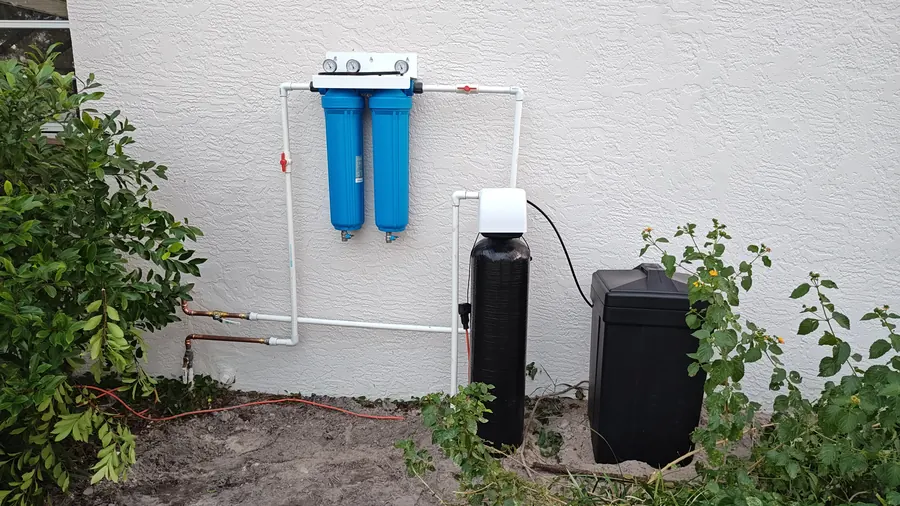
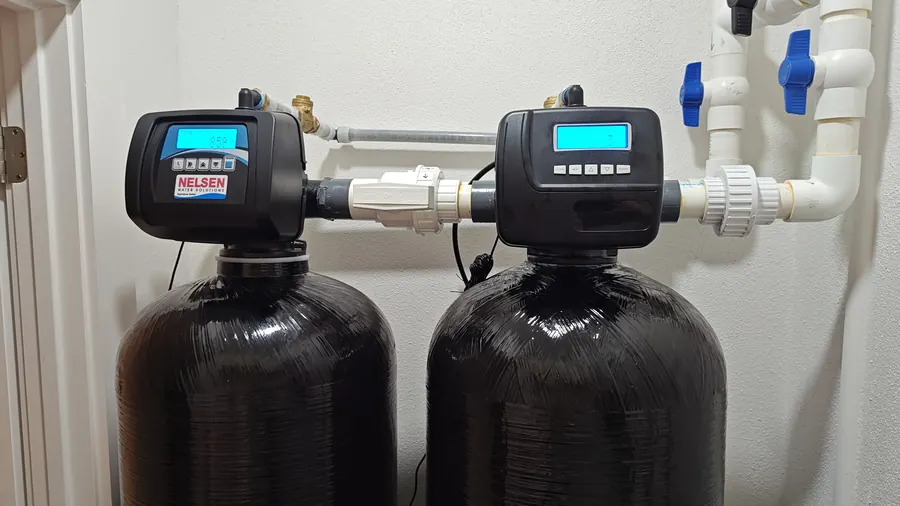
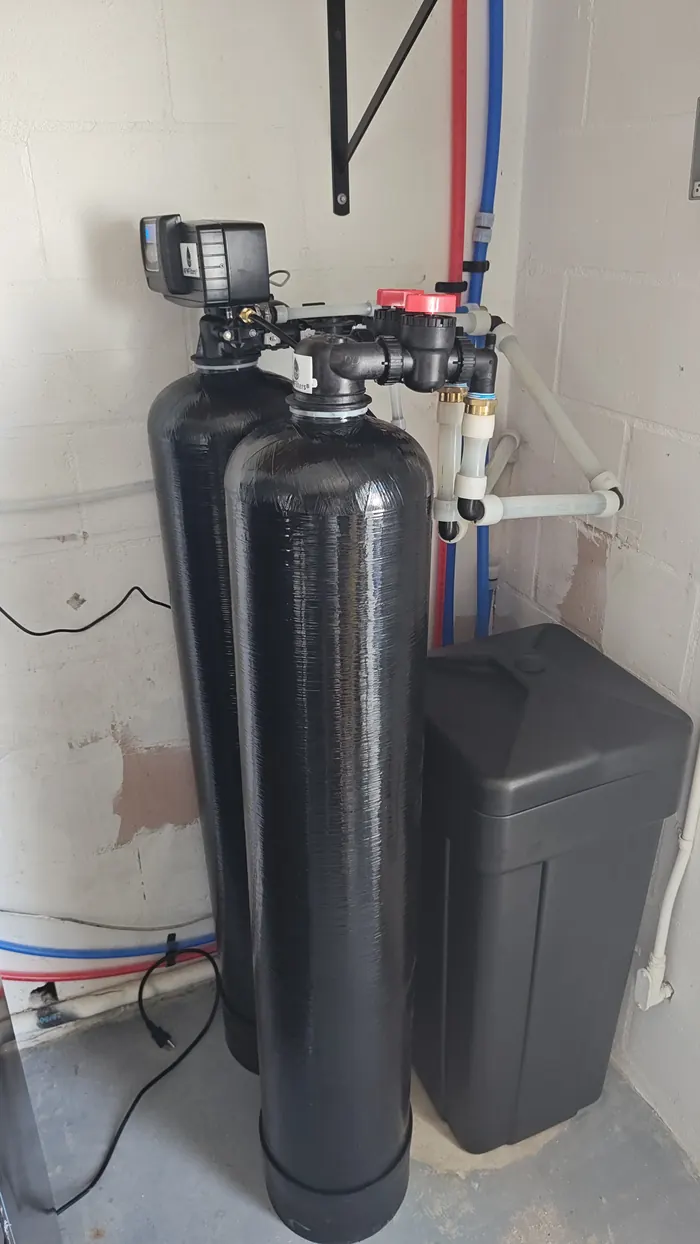
Outside on a wall, in the garage, or in a utility closet — wherever the main comes in and there's a drain for the regeneration cycle. These are our installs.
You'll meet the person who sizes it
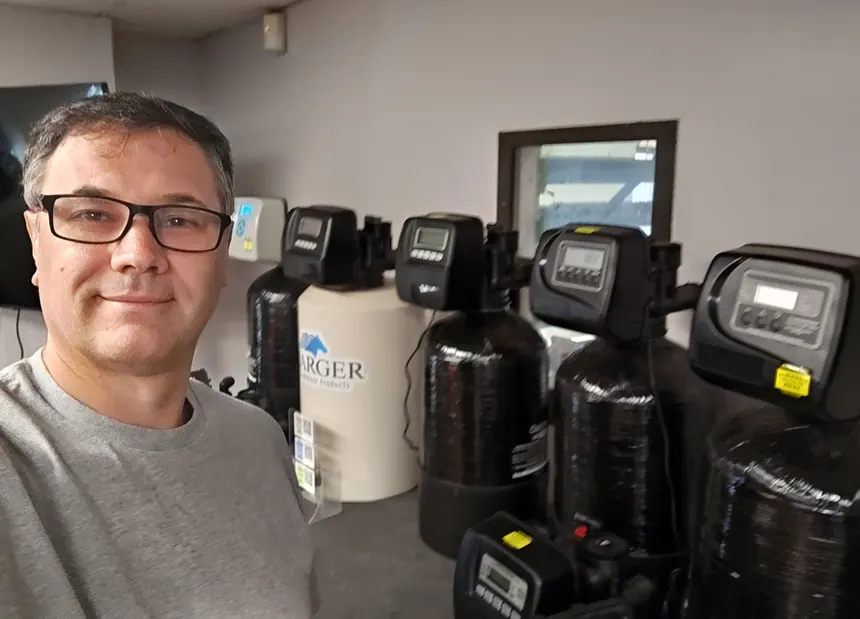
Not a commission salesman with a tablet. The person who tests your water is the person who specifies the unit and stands behind it afterwards.
What we'll tell you that a water-treatment salesman won't
Softeners are sold hard in Florida, often at the kitchen table with a pressure close. Three things that rarely come up in that conversation:
- How hard your water actually isGrains per gallon sets the capacity, which sets the tank size.
- People in the houseUsage drives how often it regenerates and how much salt it eats.
- City water or a wellWell water usually needs iron or sulphur handled ahead of the softener.
- Where the main comes inGarage, exterior wall or closet — and how far to a drain.
- A drain for the regeneration cycleIt has to discharge somewhere legal. Sometimes that's the work, not the unit.
- Metered or timed valveMetered costs more and uses less salt. We fit metered unless there's a reason not to.
What people ask
Will it make my water taste salty?
No — the salt is used to recharge the resin, not added to your drinking water. What does end up in the water is a small amount of sodium, in proportion to how hard the water was. Most people don't taste it. If you're on a sodium-restricted diet, tell us: potassium chloride works instead, and we can leave the kitchen cold line unsoftened.
How much salt will I actually be buying?
Depends on hardness and how much water the house uses. Our water page does the arithmetic with your utility's published hardness, EPA's water-use figure and today's bag price, and shows every input. A metered valve regenerating on actual use rather than a timer is the single biggest thing that keeps it down.
We're on a well. Same thing?
Usually not. Well water here often brings iron, sulphur or both, and those need handling before the softener — iron will foul softener resin. Nobody publishes a report for your well, so the test matters more, not less. We'd rather test and tell you it's a two-stage job than sell you one tank that disappoints.
Do I need a whole-house system, or just the kitchen?
Different jobs. A softener at the main protects the water heater, the pipes and the appliances — that's the scale problem. Drinking-water filtration at the kitchen is about taste and specific contaminants. Plenty of houses want both, and plenty only need one. We'll say which after the test.
Do you need a permit for this?
It depends on your jurisdiction and on what the install involves — tying into the main and running a discharge line is plumbing work. We confirm what your city or county requires before we schedule, and we pull it if it's needed.
How long do they last, and who services it?
Resin and valves are the wear items, and a well-chosen unit runs for years with nothing but salt. We install it, we service it, and we're a local phone number rather than a warranty claim to a manufacturer in another state. Softener installs carry a 1-year warranty on equipment and labour.
I already have a softener. Can you just check it?
Yes, and it's worth doing. A softener set to the wrong hardness, or one that's stopped regenerating, quietly does nothing while you keep buying salt for it. We'll test the water going in and the water coming out — that tells you in five minutes whether it's working.
Find out what's actually in your water
We test at your tap, tell you which problem you have — hardness, iron, sulphur or taste — and size the fix to it. If you don't need one, that's a fine outcome and we'll say so.